Showing posts with label crop types. Show all posts

Thursday, 5 November 2015

Forests of Carbon or Fields of Food?

 As we saw from the last post deforestation for agriculture is most likely going to occur more in the tropical regions. So if we want to quantify the effects of deforestation in these regions on carbon we need comphrensive data on carbon stocks. This is what Saatchi et al., (2010) set out to do, and through the use of Lidar, tree allometry, and spatial modelling they created a benchmark map of carbon stocks for tropical regions for the year 2000.

Figure 1 below is a map of the above ground biomass. Which is defined by the IPCC (2006) as all living biomass above the soil including stems, stumps, branches, leaves, bark, and seeds.
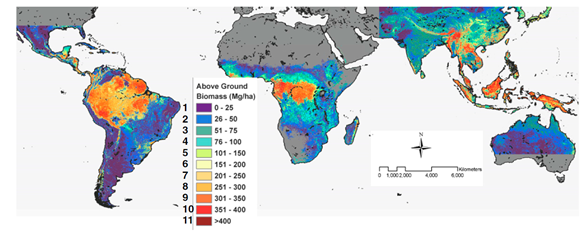


Figure 1

Figure 2 below shows the total carbon biomass (so this is the above ground biomass plus below ground biomass which is the roots) and, most importantly in my opinion, the uncertainty in these estimates. Why the uncertainty? Due to errors with estimating spatial distribution of above ground biomass from Lidar canopy height measurements, errors with estimating below ground biomass from above ground biomass, a 1km resolution might not fully capture the spatial variability in above ground biomass, and errors associated with the satellite imagery used (Saatchi et al., 2010). The supporting information accessible through their paper as 'Fig. S3' gives a good detailed breakdown.

Figure 2

We can see that these regions hold a lot of carbon! And that’s without us including the carbon in the soil as soil organic carbon! If we break this carbon storage down across the regions South America potentially stores a whopping 49% of the total stock for these regions (Saatchi et al., 2010). So how is changing land use for agriculture going affecting the carbon in these forests....  
One argument is: "weeellll we are replacing forests with crops that also use CO2 for growth and hence also store carbon as biomass, as opposed to deforesting to graze animals or build houses; so it shouldn’t make too much of a difference in terms of carbon storage what plant is growing there".  

Well, Conti ­et al., (2014) undertook a study to assess carbon storage under different land uses using biomass models* and it is an excellent example of why the above statement is really not the case! I chose this study by Conti et al., (2014) as they looked at the Chaco Forest, which is a subtropical seasonally dry forest, in South America which ties in with our carbon findings and agricultural expansion predications so far. It is also experiencing some of the highest deforestation rates for agriculture crops in the world (Conti et al., 2014).

*where you use allometic models / species specific equations to estimate biomass, then combine accordingly across a plot to obtain total biomass per hectare.

This is what they found:
Plant and soil carbon pools in the different ecosystem types.  

As we can see in the graphs, above ground biomass is significantly higher in primary forest, secondary forest, closed shrub-land and open-shrubland compared to potato crops. And the same pattern is observed for above ground dead biomass of which a potato crop has none. Looking at the amounts of organic carbon and inorganic carbon (which is the carbonate content) in the soil, we have to look at the individual layers: for the surface (0-10cm) and subsurface (10-30cm) soil layers, soil organic carbon is much higher in primary and secondary forest soils than potato crop soils. Analysing the soil inorganic carbon the authors found soils undergoing potato cultivation had the lowest amount of inorganic carbon.

Already we can see a difference in the carbon sequestration between forests and crops. Combining these results and looking at total organic amount of carbon each ecosystem has:


.....we can see the carbon lost though turning a forest into cropland: which is 31.6%! (Conti ­et al., 2014).

By switching forests of carbon for fields of food in South America we are causing less carbon to be stored on earth and more in the atmosphere, which we know as CO2 will increase earth’s global temperature. Deforestation for agricultural land is one of the reasons we have been seeing an increase in the average net CO2 emissions from land to the atmosphere over the last 10 years (IPCC 2013).  

Aggghh - so what do we do?!?!! We need to store the carbon, but we need to eat, but we are putting loads more carbon into the atmosphere, but we can’t say to developing regions: no you can’t have any more land for food stop what you are doing now.

Well that is what we will tackle in the next post: Carbon or food? What to choose.......

Thursday, 22 October 2015

The Rise of Agriculture


Agriculture [noun]: the science or practice of farming, including cultivation of the soil for the growing of crops and the rearing of animals to provide food, wool, and other products.
                                                                                                        (Oxford University Press 2015)


The main themes of my blog that I will use to explore to the effects of feeding us is how agriculture causes global environmental change through: 

                - the conversion of land 
                - the production methods used

First I thought to find out how agriculture started...

As we are delving back into time, key geological epochs to know about are the Pleistocene — which began roughly 2.58 million years ago (Gibbard and Head 2010) to roughly 11,700 years ago (Walker et al., 2009)  — and the Holocene which directly followed it. When exactly the Holocene finished (and the Anthropocene which we are in now began) is one of much debate, some interesting articles on the subject are available here and here. But for us the end of the Pleistocene and beginning of the Holocene are the most importance for agricultural origins.


From hunter-gatherers to agriculturists


Why we moved from hunter-gatherers to an agricultural society is intriguing, it is thought to be due to climatic change at the end of the Pleistocene. Through studying ice cores we can see the climate of the Pleistocene went through periods of abrupt warming and cooling (Cummings et al., 2006), and this unreliable climate is thought to have made agriculture pretty much impossible for our ancestors (Richardson et al., 2001). As the last ice age of the Pleistocene came to an end the earth entered a new epoch, the Holocene, which had a much warmer and more stable yearly climate. We can see this change in the ice cores as demonstrate in figure 1. below:
Figure 1: Graph showing isotope levels of oxygen from ice-cores, which reflect temperature changes. (Cummings et al., 2006)   
This new climate allowed agriculture to be a feasible long term option (Richardson et al., 2001), and using radiocarbon dating we can see that agriculture appeared during this time. Adapting to this changing climate, agriculture seems to have developed separately in about 9 locations (Diamond and Bellwood 2003) and then spread globally as, compared to hunting and gathering, agriculture could support larger populations. (Richardson et al., 2001, Diamond and Bellwood 2003):

Figure 2. Archeological map of agriculture homelands and spread of associated cultures, with approximate radiocarbon dates  (Diamond and Bellwood 2003). 


Exactly how those hunter-gatherers began agriculture appears to have been a fairly gradual process incorporating a combination social and technological factors (Cummings et al., 2006). Many groups already had an agricultural element to their societies from which they expanded upon and Roth (2006) provides interesting evidence for women driving the adoption of agriculture, and how it began as an extension of their 'gathering' role (girl power eh!). 

So that's how we became an agrarian society. I hope you found out something new and i''ll leave you here with this interesting tidbit:

Though agriculture dominates the globe hunter-gatherer societies still remain out there, one such example is the Sentinelese people living on North Sentinel Island in the Bay of Bengal. They are one of the last ‘un-contacted' tribes and have been able to remain this way for so long due to being incredibly hostile to any outsider contact. If you are interested in learning more about them click here.

Credit: North Sentinel Island 2015


Till next time!